Interest about dreams lead me to gain academic knowledge about human’s brain and how it functions. Dream, memory, abilities to learn, abilities to adapt enviroment and other facts about human body was always part of my curiousity. I believe that the first step of studying a brand new field is knowing the basics of it. After getting familiar with the topic, I will be able to start building my own research and knowledge in the area.
This blog will contain facts and thoughts about study areas that I never had chance before yet wanted to try previously. The first step for studying Neuroscience will be this blog.
—
What is Neuroscience?
They have various field of sciences collaborated in order to understand and accept biological basis of behavior realting to the brain.
Brain is a modular. Which means that it can be divided into multiple sets and they will strongly interact with each other to function.
—
Brain sits at the top of the CNS (Central Nervous system) which countinues with the spinal cord.
CNS = Brain + Spinal cord
PNS (Periperal Nervous System) is made out of branches from CNS.
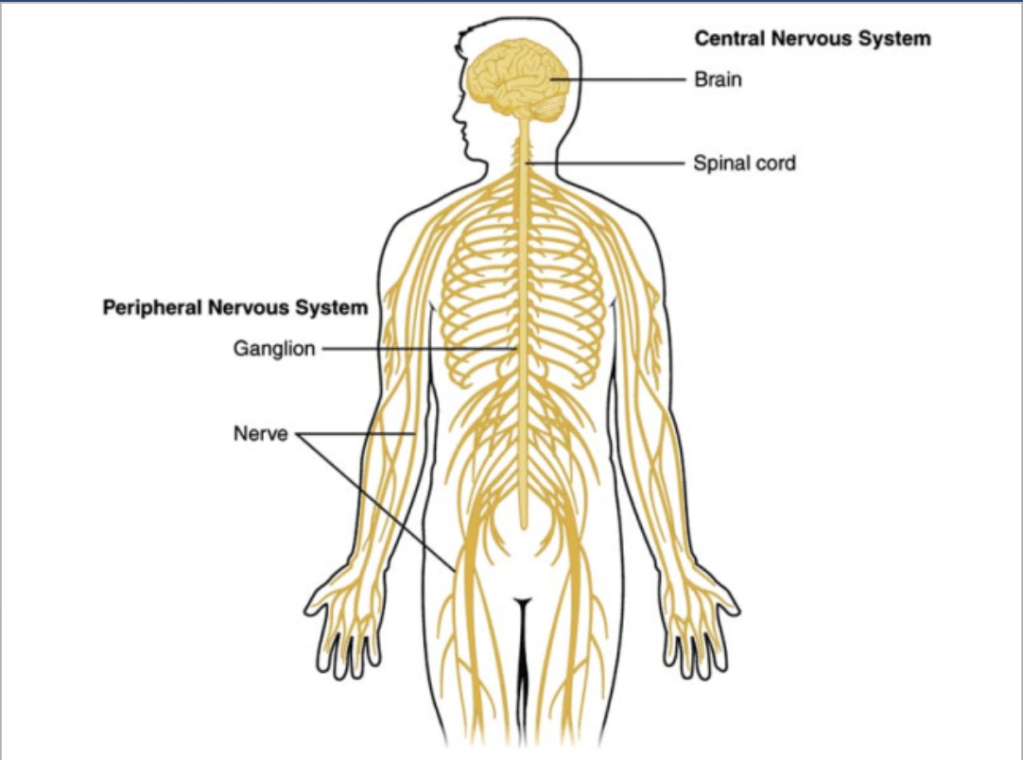
There are 12 pairs of cranial nerves and 31 pairs of spinal nerves
The CNS is the ‘central processing unit’ and the PNS forms the communication network between the ‘CPU’ and the body parts.
Brain’s protection
The brain, one of the most complex and fascinating organs in the human body, is indispensable for our existence. It serves as the epicenter of our thoughts, emotions, and actions, processing information and coordinating the functions of the entire body. The brain not only plays a crucial role in our physical well-being but also defines our identity and shapes our experiences.
Situated within the protective fortress of the skull, the brain is shielded from external harm. This bony structure serves as a formidable barrier, safeguarding this delicate organ from potential injuries that could disrupt its intricate workings. The skull acts as an intricate suit of armor, shielding the brain from external trauma and cushioning it from sudden impact.
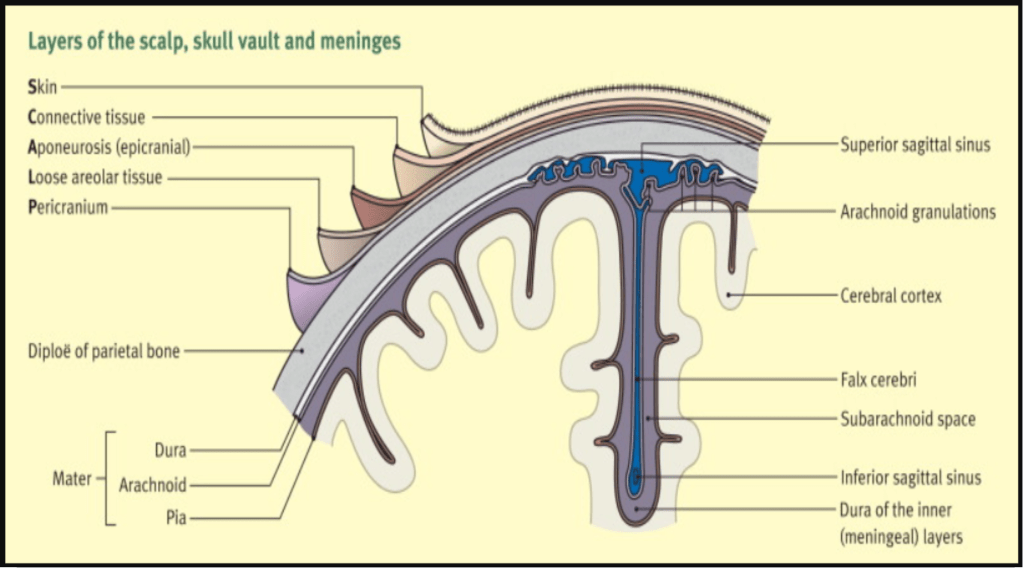
But the skull isn’t the brain’s only guardian. Meninges, a series of three protective layers, envelop and safeguard this precious mass of neural tissue. The dura mater, the toughest of the three layers, acts as the brain’s outermost shield, while the arachnoid and pia mater provide further support and cushioning.
Beyond its physical protection, the brain relies on a robust network of blood vessels to ensure its nourishment and functionality. These vessels, intricately intertwined within the brain tissue, supply it with oxygen, glucose, and other essential nutrients. Any disruption to this intricate blood supply can have profound consequences on brain function, underscoring the critical importance of maintaining a healthy cardiovascular system.
The brain, with its awe-inspiring complexity and resilience, is a marvel of evolution. Shielded within the skull and cocooned by protective barriers, this miraculous organ serves as the command center of our entire being. It is our duty to nurture and protect the brain through a healthy lifestyle, as we cherish the incredible gift of consciousness it bestows upon us.
- The S.C.A.L.P.: Skin, Dense Connective Tissue, Epicranial Aponeurosis, Loose Areolar Connective Tissue and Periosteum.
- The meninges: Three layers of membranes that surround the CNS (brain and spinal cord). From outer to inner: Dura matter, arachnoid matter and pia matter.
- CSF (Cerebrospinal fluid): Underneath the arachnoid matter, there’s a space called the SUBARACHNOID SPACE which is filled with Cerebrospinal fluid. CSF functions as a shock absorber.
- The skull: the bony encasement around the brain
Planes of the brain

Brain is a three-dimentional structure which shows different shape from each plane. Locating and making discription becomes highly precise and detailed if we look at varous planes.
The Cerebrum
The surface of the cerebrum is very “wrinkled” due to a structure known as the cortex. The cortex is made up of billions of neurons, which are the basic building blocks of the brain. These neurons are responsible for processing information, controlling movement, and performing various cognitive functions. The wrinkled appearance of the cortex, with its numerous folds and grooves, is called sulci and gyri. This folding greatly increases the surface area of the cerebrum, allowing for more neurons to be packed into a limited space. The increased surface area enables more complex cognitive abilities, such as perception, memory, language, and thought. It is fascinating to think that these intricate folds play a crucial role in our ability to perceive and interact with the world around us.
This convoluted surface of the cerebrum is called the CORTEX. The cortex is made up of grey matter: an aggregate of neuronal cell bodies. The two cerebral hemispheres are only connected by the CORPUS CALLOSUM.
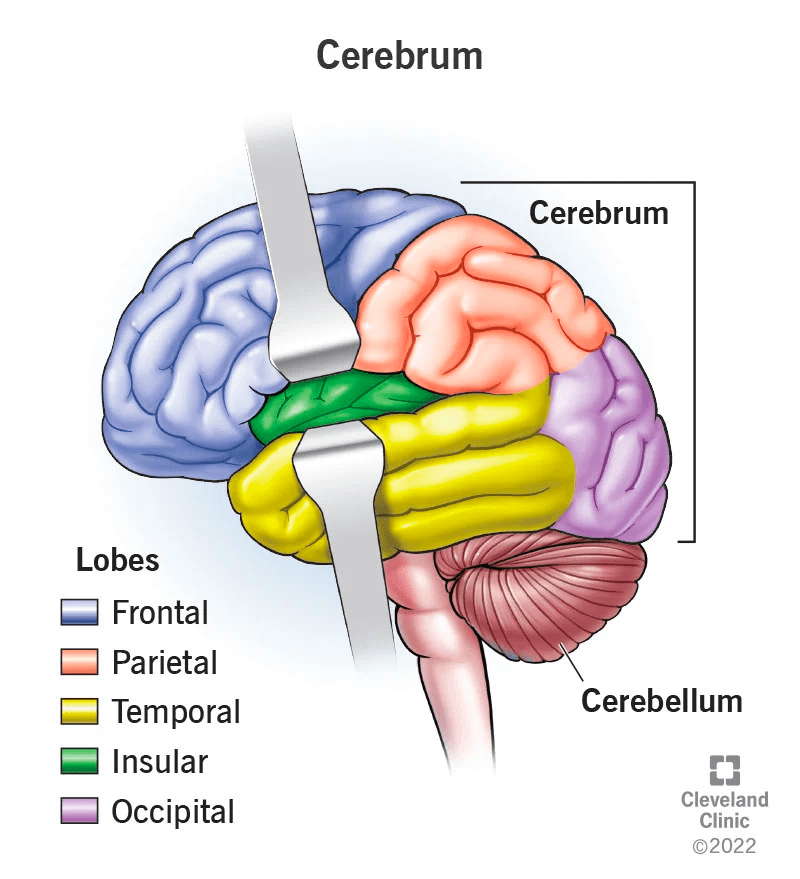
Cerebral lobes and key functions
Collectively, the cerebral cortex is involved in higher-level processing in the brain covering language, memory, judgment, learning and decision making.
The localization of functions is not entirely strict as empirical findings show that the brain functions as a whole even though it is modular.
- Frontal lobe: responsible for higher cognitive functions such as memory, emotions, impulse control, problem solving, social interaction, and motor function.
- Temporal lobe: lateralization of some functions in most individuals.
- Parietal lobe: sensory perception and integration, including the management of taste, hearing, sight, touch, and smell.
- Occipital lobe: majorly concerned with visual processing and interpretation. The primary visual cortex is found here.
Frontal lobe
The frontal lobe of the brain is responsible for various cognitive functions and behaviors. It plays a crucial role in memory, emotions, impulse control, decision-making, problem-solving, social interactions, motor coordination, and language processing. Together, these abilities contribute to our overall cognitive and social functioning.
Temporal lobe
The auditory cortex is found within the sylvian fissure which separates the temporal lobe from the parietal. The temporal lobe shows lateralization of some functions in most individuals.
There are left and right side of the temporal lobe, and the left temporal lobe helps us understanding language, learning, memorizing, forming speech and remembering verbal information. Right side of it assists us to procees learning and memorizing non-verbal information (e.g. drawings and music), recognizing information, and determining facial expressions.
Parietal lobe
Sensory integration and self-perception, including spatial awareness and object location, are important functions of the Parietal lobe. This region of the brain helps us to understand our position in space and the location of objects around us. It also integrates multiple body maps, allowing us to have a coherent perception of our own body and its relationship to the external world.
Occipital lobe
The occipital lobe, located at the back of the brain, plays a vital role in the processing and interpretation of visual information. It is the primary site for visual processing and features the primary visual cortex, also known as V1 or the striate cortex. This region is responsible for receiving and analyzing visual input from the eyes.
The occipital lobe is divided into several functional areas that work together to make sense of visual stimuli. These areas include V2, V3, V4, and V5, each specializing in different aspects of visual processing.
V2 is involved in basic visual feature detection, such as edges and orientations, while V3 helps with the perception of motion. V4 is responsible for color perception, and V5 processes information related to object motion and visual attention.
Visual information processed in the occipital lobe is then sent to other regions of the brain for further analysis and interpretation. For example, the information may be relayed to the parietal lobe to help with spatial awareness and the recognition of objects in different orientations. It may also be transmitted to the temporal lobe for the identification of familiar faces or objects.
The occipital lobe is a crucial component of the brain’s visual system. Its specialized areas work in harmony to process and interpret visual information, allowing us to perceive the world around us.
Links I have looked into:
https://teachmeanatomy.info/head/areas/scalp/
https://www.health.qld.gov.au/abios/asp/bfrontal
https://www.health.qld.gov.au/abios/asp/bparietal
https://www.health.qld.gov.au/abios/asp/boccipital
https://www.health.qld.gov.au/abios/asp/btemporal_lobes
https://www.health.qld.gov.au/abios/asp/brain
https://www.ageuk.org.uk/information-advice/health-wellbeing/mind-body/staying-sharp/your-brain/
 Spill out my mind
Leave a comment